
Sagrada Familia Barcelona: History, Tickets, Towers & Travel Guide
Sagrada Familia Barcelona: Complete History, Architecture, Tickets and Travel Guide
If you are planning a trip to Barcelona, there is one landmark that deserves a special place on your itinerary: Sagrada Familia Barcelona.
Standing in the heart of the city, the Sagrada Família is much more than a beautiful church. It is one of Barcelona’s most recognizable landmarks, a masterpiece associated with the architect Antoni Gaudí, and a building whose construction has continued across generations.
From its extraordinary façades and enormous towers to its colorful interior filled with natural light, almost every part of the Sagrada Família tells a story.
In this complete Sagrada Familia Barcelona travel guide, you will discover its history, the story of Antoni Gaudí, the meaning behind the façades and towers, what you can see inside, how to get there, when to visit, what tickets include, photography tips, and practical advice for making the most of your visit.
Whether you are visiting Barcelona for the first time or have lived in the city for years, the Sagrada Família is a place worth seeing from both the outside and inside.
What Is Sagrada Familia Barcelona?
The Sagrada Família, officially known as the Basilica of the Sagrada Família, is a large Roman Catholic basilica in Barcelona, Spain.
The project began in 1882, originally under architect Francisco de Paula del Villar. In 1883, Antoni Gaudí took over the project and transformed it into the extraordinary architectural vision that made the building famous around the world.
Gaudí devoted an increasingly large part of his life to the Sagrada Família. From 1914 until his death in 1926, he worked exclusively on the temple.
The building combines religious symbolism with innovative architectural techniques, sculptural details and an extraordinary use of light.
Today, the Sagrada Família remains one of Barcelona’s most important landmarks and is also associated with the UNESCO World Heritage recognition of Gaudí’s work. UNESCO specifically includes the Nativity façade and Crypt of the Sagrada Família among the components of the “Works of Antoni Gaudí” World Heritage property.
The History of Sagrada Familia
The history of the Sagrada Família is one of the most fascinating parts of visiting the basilica.
Construction started in the nineteenth century, but the building was never intended to be completed quickly. Its enormous scale, detailed decoration, religious symbolism and changing construction methods made it a project spanning many generations.
The Beginning of the Project
Construction began in 1882.
The original project was designed by architect Francisco de Paula del Villar, and the cornerstone was laid on 19 March 1882.
However, Villar eventually left the project.
The following year, Antoni Gaudí became responsible for the design and gradually transformed the original concept into something completely different.
Antoni Gaudí Takes Over
When Gaudí took over in 1883, he developed a much more ambitious vision for the temple.
Instead of simply creating another conventional church, Gaudí imagined an enormous structure filled with symbolism, geometric forms, natural inspiration and dramatic vertical spaces.
The Sagrada Família became the central architectural project of his later life.
By 1914, Gaudí had stopped working on his other major projects so that he could concentrate entirely on the basilica.
Gaudí’s Death
Antoni Gaudí died in 1926 after being struck by a tram in Barcelona.
His death was a major turning point for the project.
Gaudí had left drawings, models and ideas for future generations, but the building was far from finished.
Construction therefore continued under other architects and craftsmen.
The Spanish Civil War
The Sagrada Família also suffered during the Spanish Civil War.
In 1936, Gaudí’s workshop was vandalized, and many of his original models, plans and photographs were damaged or destroyed.
Fortunately, some material survived, and architects working on the project later used the remaining information, reconstructed models and published documentation to continue the work.
This is one reason the history of the Sagrada Família is not simply the story of one architect. It is also the story of generations of people who continued working to develop Gaudí’s vision.
Antoni Gaudí and Sagrada Familia
Who Was Antoni Gaudí?
Antoni Gaudí was a Catalan architect born in 1852 who became one of the most influential figures of Catalan Modernisme.
His architecture is famous for unusual shapes, organic forms, detailed ornamentation, structural experimentation and the integration of architecture with sculpture and decorative arts.
Gaudí did not simply think about buildings as boxes with walls and roofs.
He studied nature, geometry, light and structure and incorporated these ideas into his architecture.
His work can be seen throughout Barcelona, including places such as Park Güell, Casa Batlló, Casa Milà and Casa Vicens.
UNESCO recognizes seven properties connected with Gaudí as part of the World Heritage property “Works of Antoni Gaudí.” The Sagrada Família’s Nativity façade and Crypt are included in that group.
Sagrada Familia Architecture
The architecture is one of the main reasons millions of people are fascinated by Sagrada Familia Barcelona.
The building combines Gothic influences with Gaudí’s highly personal architectural language.
Instead of relying only on straight lines and conventional forms, Gaudí developed complex structures inspired partly by natural shapes.
The Towers of Sagrada Familia
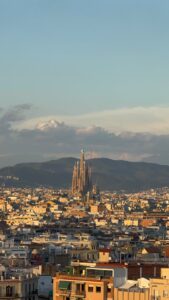
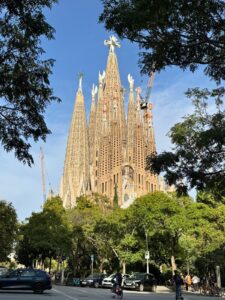
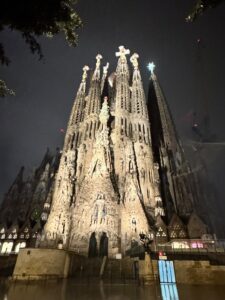
One of the first things visitors notice is the incredible collection of towers.
The towers dominate Barcelona’s skyline and were designed with religious symbolism.
The central group represents important figures in Christianity, while other towers are associated with the Evangelists, the Virgin Mary and Jesus Christ.
The towers are not simply decorative.
They form an important part of the basilica’s overall symbolism and architectural composition.
The Central Tower of Jesus Christ
One of the most important recent developments occurred in 2026.
According to the official Sagrada Família history, on 20 February 2026, the exterior of the central Jesus Christ tower was completed with the installation of the upper arm of the cross.
This was an extraordinary milestone in the long history of the basilica.
The central Jesus Christ tower is the tallest tower of the temple and represents the culmination of the central tower group.
For visitors in Barcelona today, this makes 2026 a particularly interesting year to experience the evolving skyline of the Sagrada Família
The Three Major Facades of Sagrada Familia
The Sagrada Família is particularly famous for its richly decorated façades.
Each major façade has its own artistic style and religious meaning.
Nativity Façade
The Nativity façade is closely associated with the birth of Jesus.
It is one of the areas most strongly connected to Gaudí’s own work.
The façade contains an extraordinary amount of sculptural detail, including figures, plants, animals and architectural elements.
Rather than looking like a flat wall, it feels almost alive.
Why the Nativity Façade Is Special
The Nativity façade was developed during Gaudí’s lifetime, and UNESCO specifically recognizes Gaudí’s work on the Nativity façade and Crypt as part of the World Heritage property.
If you are interested in understanding Gaudí’s original artistic vision, this is one of the most important parts of the basilica to study.
Passion Façade
The Passion façade represents the suffering and death of Jesus.
Its appearance is dramatically different from the Nativity façade.
While the Nativity façade is extremely detailed and organic, the Passion façade has a much more severe and angular appearance.
The sculptural figures tell scenes associated with the Passion of Christ.
This contrast between the two façades is intentional.
It allows visitors to experience two very different artistic interpretations of religious history on the same building.
Glory Façade
The Glory façade is designed as the principal entrance associated with the glory of God.
It is also the largest of the three major façades.
Its development has formed an important part of the continuing construction of the basilica.
The Glory façade represents the final major stage of the temple’s external composition.
What Is Inside Sagrada Familia?
Walking inside Sagrada Familia Barcelona is completely different from looking at photographs of the exterior.
The first thing many visitors notice is the enormous amount of natural light.
Large stained-glass windows allow sunlight to enter the basilica and create changing colors across the interior.
The Columns
The interior columns are among the most impressive architectural features.
Gaudí designed the structural system so that columns branch upward in ways that can remind visitors of trees.
This creates the feeling of standing inside a huge stone forest.
Look upward when you visit.
The ceiling is one of the easiest details to miss if you spend all your time looking at the walls.
Light and Stained Glass
Light plays a major role in the interior design.
The stained-glass windows produce different atmospheres depending on the position of the sun.
This means the basilica can look noticeably different in the morning, afternoon and evening.
The changing light is one of the reasons it is worth spending enough time inside rather than simply entering, taking a few photographs and leaving.
Sagrada Familia Museum
A visit to Sagrada Familia can also include the museum area, where visitors can learn more about the history of the project, Gaudí’s life and the construction process.
The museum helps explain something that can otherwise be difficult to understand:
How can a building designed more than a century ago still be under construction today?
Models, historical information and architectural material help visitors understand how the project developed from Gaudí’s original ideas into the enormous basilica seen today.
If you enjoy architecture or history, give yourself extra time for this section.
Sagrada Familia Towers
One of the most popular experiences is visiting one of the towers.
A tower visit gives you a different perspective of both the basilica and Barcelona.
Depending on the ticket and availability, visitors can choose between tower experiences associated with the Nativity or Passion façades.
The official Sagrada Família currently offers ticket options that include access to a tower, with the visit including the basilica, museum and downloadable audioguide.
Is the Tower Visit Worth It?
For many visitors, yes.
If you enjoy city views and architecture, seeing Barcelona from the tower adds another dimension to the visit.
However, tower access is not suitable for everyone.
The official site notes that the towers are not accessible for people with reduced mobility or functional diversity, and visitors go up by lift and walk down.
Sagrada Familia Tickets
One of the most important things to know before visiting is that you should plan your ticket in advance.
The official Sagrada Família website provides different ticket options, including basic basilica visits, guided tours and options that include tower access.
At the time of writing, the official ticket site lists the following examples:
- Sagrada Família with audioguide
- Sagrada Família with guided tour
- Sagrada Família with tower access
- Guided tour with tower access
Prices and ticket options can change, so always check the official ticket system before your visit.
Should You Buy Tickets in Advance?
Yes, especially during busy travel periods.
The official website states that tickets can currently be purchased approximately two months before the visit.
Advance tickets also help you avoid unnecessary waiting and ensure that you have an allocated entry time.
Sagrada Familia Opening Hours
Opening hours vary depending on the season.
According to the official Sagrada Família website:
November to February
Monday–Saturday: 9:00 AM–6:00 PM
Sunday: 10:30 AM–6:00 PM
March and October
Monday–Friday: 9:00 AM–7:00 PM
Saturday: 9:00 AM–6:00 PM
Sunday: 10:30 AM–7:00 PM
April to September
Monday–Friday: 9:00 AM–8:00 PM
Saturday: 9:00 AM–6:00 PM
Sunday: 10:30 AM–8:00 PM
Opening hours can occasionally change because of special events inside the basilica, so check the official website before travelling.
How to Get to Sagrada Familia Barcelona
Getting to Sagrada Familia is relatively easy because the basilica is connected to Barcelona’s public transportation network.
By Metro
The easiest option for many tourists is the Barcelona Metro.
Use:
L2 – Purple Line
L5 – Blue Line
Both stop at Sagrada Família station.
Once you leave the station, the basilica is immediately nearby.
By Bus
Several bus routes also serve the area, including:
- 19
- 33
- 34
- D50
- H10
- B24
Always check the current Barcelona public transport information before travelling because routes and schedules can change.
The Best Time to Visit Sagrada Familia
Choosing the right time can make a big difference.
Early Morning
Morning visits can be a good option if you want to experience the basilica before the busiest part of the day.
The official website also introduced a quiet hour from 9:00 AM to 10:00 AM starting 2 February 2026. During this period, visitors are asked to maintain silence and audio from mobile devices or audioguides must be used with earphones.
If you want a more peaceful experience, this is worth considering.
Afternoon
Afternoon light can create beautiful colors inside the basilica.
The exact appearance changes according to the season, weather and position of the sun.
For photographers, this can be particularly interesting.
How Long Do You Need at Sagrada Familia?
I recommend allowing at least 1.5 to 2 hours if you want to properly experience the basilica.
You may need more time if you:
- Visit a tower
- Explore the museum
- Listen to the full audioguide
- Take photographs
- Study the façades
- Want to explore the surrounding neighborhood
The official tower experience itself lists an approximate duration of 1 hour and 30 minutes.
Photography Tips for Sagrada Familia
If you are planning to take your own photographs for your travel blog, Sagrada Familia offers countless opportunities.
Photograph the Exterior
Instead of taking only one straight-on photograph, walk around the surrounding streets.
Try different distances and angles.
The contrast between the enormous towers and Barcelona’s surrounding buildings can create much more interesting photographs.
Photograph the Interior
Inside, look upward.
The columns, ceiling, windows and changing light create some of the most memorable photographs.
Remember that Sagrada Família is a religious space, so visitors should be respectful and follow the basilica’s photography and visitor rules.
Take Your Own Original Photos
For a travel website, original photography can be especially useful.
Your own photographs can make the article more personal and help readers understand that you are sharing a real travel experience rather than simply rewriting information from another website.
Sagrada Familia Travel Tips
1. Buy Your Ticket Before You Go
Do not leave your visit completely to chance during busy periods.
Check official availability and choose your preferred time in advance.
2. Arrive Before Your Time Slot
Your ticket is connected to a specific access time.
The official website advises visitors to respect their allocated entry time.
3. Download the Official App
If your ticket includes the audioguide, download the official Sagrada Família app before arriving.
Also bring headphones.
4. Charge Your Phone
This sounds simple, but it is important.
If you are using the official app, taking photographs and using your digital ticket, your phone battery can disappear quickly.
5. Dress Respectfully
Remember that Sagrada Família is a basilica and a place of worship.
Wear appropriate clothing and behave respectfully while inside.
6. Don’t Rush
The Sagrada Família is not a monument that you should experience in ten minutes.
Look carefully at the sculptures.
Study the columns.
Look at the ceiling.
Notice the changing light.
Then step outside and look at the façades again.
The more time you spend looking, the more details you will discover.
Interesting Facts About Sagrada Familia
1. Construction began in 1882
The project started more than a century ago.
2. Gaudí did not design the original project
Francisco de Paula del Villar began the project before Gaudí took over.
3. Gaudí spent much of his later life working on Sagrada Familia
By 1914, he had dedicated himself entirely to the temple.
4. Gaudí died before the basilica was completed
He died in 1926, leaving future generations to continue the project.
5. The building survived major historical difficulties
The project continued through periods of political and social upheaval, including the Spanish Civil War.
6. The Nativity façade is particularly connected with Gaudí’s original work
This is one reason it has such importance in understanding his architectural vision.
7. The interior resembles a Forest
The branching columns create an extraordinary natural impression.
8. Light is an essential part of the architecture
The stained-glass windows transform the interior throughout the day.
9. The Sagrada Família is still connected with ongoing construction
The project has continued across generations.
10. 2026 is a historic year for the basilica
In February 2026, the exterior of the central Jesus Christ tower was completed, marking a major milestone in the temple’s history.
Is Sagrada Familia Worth Visiting?
Absolutely.
Even if you are not particularly interested in churches or architecture, the Sagrada Família is one of those places that is difficult to understand fully from photographs.
The scale is impressive.
The details are extraordinary.
The interior light is constantly changing.
And the history behind the building makes the experience even more interesting.
If you are visiting Barcelona for the first time, I would put Sagrada Familia high on your list.
If you have already visited Barcelona but only seen the basilica from outside, going inside can feel like discovering a completely different building.
Sagrada Familia vs Seeing It From Outside
There is nothing wrong with photographing the Sagrada Família from the streets around it.
In fact, the exterior is spectacular.
But seeing the basilica only from outside means missing a huge part of the experience.
Inside, you can see:
- The enormous columns
- The colorful stained-glass windows
- The geometric ceiling
- The religious symbolism
- The museum
- Architectural details that are difficult to understand from outside
For a first-time visitor, I would recommend experiencing both the exterior and interior.
A Simple Sagrada Familia Barcelona Itinerary
If you only have a few hours, here is a simple plan.
Step 1 – Arrive at Sagrada Família
Take Metro L2 or L5 to Sagrada Família station.
Step 2 – Walk Around the Basilica
Before entering, spend some time looking at the exterior.
Visit both the Nativity and Passion sides if possible.
Step 3 – Enter the Basilica
Use your allocated entrance time.
Step 4 – Explore the Interior
Take your time looking at the columns, ceiling and stained glass.
Step 5 – Visit the Museum
Learn about Gaudí and the construction of the temple.
Step 6 – Visit a Tower
If your ticket includes tower access and you are comfortable with the experience, enjoy the views over Barcelona.
Step 7 – Explore the Neighborhood
After leaving, walk around the surrounding streets and take some additional photographs.
Official Sagrada Família website
Frequently Asked Questions About Sagrada Familia Barcelona
Is Sagrada Familia worth visiting?
Yes. Sagrada Familia is one of Barcelona’s most important landmarks and offers a unique combination of architecture, religious symbolism, history and art.
How old is Sagrada Familia?
Construction began in 1882, making the project more than 140 years old as of 2026.
Who designed Sagrada Familia?
The project has continued for generations. A major milestone was reached in February 2026 when the exterior of the central Jesus Christ tower was completed.
Can you visit Sagrada Familia inside?
Yes. Visitors can purchase tickets for access to the basilica, with options that may also include an audioguide, guided tour or tower visit.
Can you visit the towers?
Yes. Certain ticket options include access to one of the towers. Tower access is subject to availability and visitor requirements.
How do I get to Sagrada Familia?
The easiest public transportation option is usually the Metro. Sagrada Família station is served by Metro lines L2 and L5.
How long should I spend at Sagrada Familia?
Around 1.5 to 2 hours is a reasonable starting point, although visitors who want to explore the museum, take photographs and visit a tower may want additional time.
What is the best time to visit Sagrada Familia?
Early morning can be good for a quieter experience, while different times of day offer different lighting inside the basilica. The official site currently designates 9:00–10:00 AM as a quiet hour.
Is Sagrada Familia a UNESCO World Heritage Site?
The Nativity façade and Crypt of the Sagrada Família are included in UNESCO’s World Heritage property “Works of Antoni Gaudí.”
Final Thoughts on Sagrada Familia Barcelona
The Sagrada Família is not simply another attraction to check off your Barcelona itinerary.
It is a building shaped by more than a century of history, architectural experimentation, religious symbolism and human creativity.
Antoni Gaudí began transforming the project in the nineteenth century, but he never lived to see the completed vision.
Generations of architects, artists, craftsmen and builders continued the work.
That long history is part of what makes the Sagrada Família so fascinating.
When you stand beneath the enormous interior columns and watch sunlight pass through the stained glass, it becomes easier to understand why this building has become one of Barcelona’s defining landmarks.
And with major milestones continuing into 2026, the story of the Sagrada Família is still being written.
If you are planning a trip to Barcelona, make time to experience Sagrada Familia from both outside and inside. Look closely, take your time, and don’t forget to look up.
3 thoughts on “Sagrada Familia Barcelona: History, Tickets, Towers & Travel Guide”
Comments are closed.