La Rambla Barcelona: 9 Amazing Attractions & Travel Tips
La Rambla Barcelona: Complete History, Attractions and Travel Guide
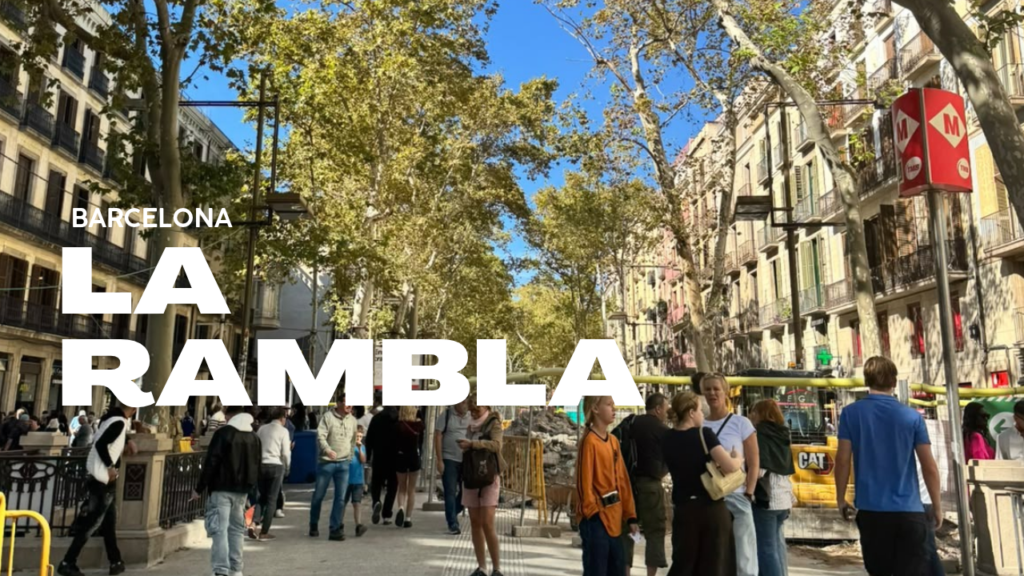
La Rambla Barcelona is one of the most famous streets in Spain and a must-visit destination for travellers exploring the Catalan capital. Stretching between Plaça de Catalunya and the waterfront near Port Vell, this historic pedestrian promenade offers a fascinating combination of architecture, culture, markets, restaurants, street performers and centuries of Barcelona’s history.
Whether you are visiting Barcelona for the first time, planning a weekend city break, or living in the city and looking for somewhere new to explore, La Rambla offers an excellent starting point for discovering the historic centre.
However, La Rambla is much more than a busy tourist street. Its origins are connected to the city’s medieval development, religious institutions, public markets and transformation into a modern European destination. Along the route, visitors can discover the famous Canaletes Fountain, La Boqueria Market, the Gran Teatre del Liceu, historic palaces and the Columbus Monument near the port.
In this complete La Rambla Barcelona travel guide, you will learn about the street’s history, architectural landmarks, different sections, nearby attractions, transport options, walking routes, safety considerations and practical travel tips.
Where Is La Rambla in Barcelona?
La Rambla is located in the Ciutat Vella district, the historic heart of Barcelona. It connects Plaça de Catalunya at its northern end with the Columbus Monument and the waterfront area near Port Vell at its southern end.
The promenade forms an important boundary between two historic neighbourhoods: the Barri Gòtic, or Gothic Quarter, to the east and El Raval to the west.
Its central location makes La Rambla an ideal starting point for exploring Barcelona on foot. Visitors can easily combine a walk along the boulevard with a visit to the Gothic Quarter, La Boqueria Market, the waterfront, historic churches and nearby museums.
La Rambla is approximately 1.2 kilometres long. The main promenade can be explored in around 20–30 minutes without stopping, although most visitors need one to three hours to enjoy the attractions and surrounding streets.
Why Is La Rambla So Famous?
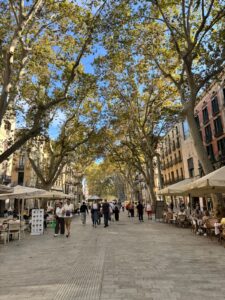
La Rambla is famous for its lively atmosphere, historic buildings, flower stalls, pedestrian walkways and position at the centre of Barcelona’s visitor scene.
Its main attractions include:
- Canaletes Fountain, associated with a local tradition about returning to Barcelona.
- La Boqueria Market, known for fresh produce, food stalls and Catalan specialities.
- Gran Teatre del Liceu, one of the city’s most important opera houses.
- Palau de la Virreina, a notable historic palace.
- Plaça Reial, a beautiful square just off the boulevard.
- Columbus Monument, near the waterfront at the southern end.
The street is also a place to observe everyday urban life, from local residents meeting friends to visitors discovering the city for the first time.
The History of La Rambla Barcelona
Understanding the history of La Rambla makes a walk along the street much more interesting. Its development reflects the expansion of Barcelona from a walled medieval city into a major cultural, commercial and tourist destination.
Ancient Origins and the Meaning of Rambla
The word “rambla” is connected to the Arabic word ramla, meaning sandy ground. In the Iberian Peninsula, the term became associated with a dry watercourse or channel that carries water during periods of rain.
The area around present-day La Rambla was historically associated with streams and watercourses outside the core of the ancient city. The precise history of the area’s natural drainage is complex, but the street’s name preserves a connection to its watery landscape.
The Roman city of Barcino, which developed into modern Barcelona, was considerably smaller than the city visitors see today. As the settlement expanded over many centuries, its boundaries and surrounding areas changed.
La Rambla During the Middle Ages
During the medieval period, Barcelona was protected by successive defensive walls. La Rambla developed alongside the western side of the medieval city and eventually became an important corridor between the old urban centre and the areas that grew beyond it.
The construction and extension of the city’s walls changed the relationship between the street and surrounding neighbourhoods. As urban development progressed, the watercourse was diverted and the area gradually became suitable for movement, commerce and public activity.
Religious communities and other institutions established buildings along the route. These developments helped transform the area from a boundary of the city into an increasingly important part of urban life.
The Transformation of La Rambla in the 18th Century
The eighteenth century was a turning point in the development of La Rambla. Barcelona began reshaping the area into a broad public promenade, creating a place where people could walk, meet and enjoy leisure time.
In 1766, a major stage in the street’s development established its modern character as a promenade following the route of the former medieval walls.
This was particularly important because much of the historic city consisted of narrow streets and compact buildings. La Rambla provided a wider public space where different social groups could gather.
Trees were planted, commercial activity expanded and the street became an increasingly popular place for social encounters.
La Rambla in the 19th Century
During the nineteenth century, La Rambla developed into one of Barcelona’s most recognisable public spaces. Shops, cafés, cultural venues, flower sellers and kiosks contributed to its lively atmosphere.
The growth of entertainment and cultural institutions strengthened the street’s reputation. The Gran Teatre del Liceu became an important centre for opera, while markets and commercial businesses attracted residents from different parts of the city.
The boulevard also became associated with strolling, meeting friends and observing public life. This tradition of walking along La Rambla continues today.
La Rambla in the 20th Century
During the twentieth century, La Rambla experienced political change, economic challenges, urban transformation and changing patterns of tourism.
The surrounding historic neighbourhoods retained their distinctive character, while the boulevard became increasingly known internationally. Cultural venues, markets, shops and cafés continued to attract visitors.
Like many historic urban areas, La Rambla also faced challenges involving the preservation of traditional businesses, changing commercial activity and the pressure created by increasing visitor numbers.
La Rambla Today
Today, La Rambla remains one of Barcelona’s best-known streets. It connects historic architecture with contemporary city life and provides access to major attractions, cultural institutions, restaurants and the waterfront.
The street is a popular place for sightseeing, photography and walking tours. At the same time, it is part of a living neighbourhood, so visitors should respect residents, public spaces and local businesses.
La Rambla’s importance lies not only in its popularity but also in the way it illustrates Barcelona’s transformation across many centuries.
Sagrada Familia Barcelona: History, Tickets, Towers & Travel Guide
The Five Historic Sections of La Rambla
La Rambla is often described as a single street, but it traditionally consists of several sections with their own names and histories. Walking from Plaça de Catalunya towards the sea reveals these different identities.
1. Rambla de Canaletes
Rambla de Canaletes is the northern section, closest to Plaça de Catalunya.
Its best-known landmark is the Canaletes Fountain, a traditional meeting point for Barcelona residents and football supporters.
Canaletes Fountain
The fountain is connected to a popular local belief: anyone who drinks its water will return to Barcelona. Although this is a tradition rather than a guarantee, it has become part of the city’s tourism folklore.
The area is also associated with celebrations by FC Barcelona supporters following important victories.
Visitors can stop here at the beginning of their walk and explore the surrounding streets before continuing down the promenade.
2. Rambla dels Estudis
The next section takes its name from the historic Estudi General, an early university institution that once stood in the area.
This part of La Rambla reflects Barcelona’s religious, educational and architectural heritage.
Notable landmarks nearby include the Church of Betlem and Palau Moja. Their historic façades provide a contrast with the busy commercial activity along the promenade.
The section also illustrates how La Rambla evolved from a boundary area into a centre for public life.
3. Rambla de Sant Josep
Rambla de Sant Josep is widely associated with La Rambla’s traditional flower market and is often called Rambla de les Flors, or the Rambla of Flowers.
Flower stalls have long contributed to the street’s visual identity. Their colourful displays offer a different atmosphere from the surrounding shops and restaurants.
This section is also the part of the promenade closest to La Boqueria Market, making it an excellent stop for travellers interested in food, photography and local traditions.
4. Rambla dels Caputxins
Rambla dels Caputxins is associated with the former Capuchin religious community.
It is one of the most culturally significant stretches of the boulevard. The nearby Gran Teatre del Liceu and access to Plaça Reial make this area particularly interesting for architecture and performing arts enthusiasts.
The section combines historic façades, entertainment venues and busy pedestrian areas.
5. Rambla de Santa Mònica
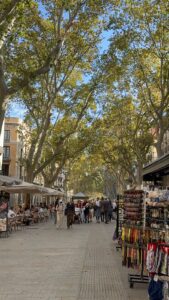
Rambla de Santa Mònica forms the southern section, leading towards the waterfront and Columbus Monument.
The section takes its name from the historic Santa Mònica religious complex. Today, this part of La Rambla offers access to cultural spaces and the wider Port Vell area.
It is a convenient place to conclude a walking tour before continuing towards the harbour.
Best Things to See on La Rambla Barcelona
There are many attractions to explore along and around La Rambla. Some are located directly on the boulevard, while others can be reached through nearby side streets.
1. Plaça de Catalunya
Plaça de Catalunya is the northern starting point of La Rambla and one of Barcelona’s principal public squares.
The square connects the historic centre with the Eixample district and is surrounded by shops, hotels and transport connections.
It is an ideal meeting point for walking tours and a convenient location for visitors arriving from other parts of Barcelona.
Allow 10–20 minutes to explore the square before beginning your walk.
2. Canaletes Fountain
Canaletes Fountain is one of the most recognisable landmarks on La Rambla.
Its association with the tradition of returning to Barcelona makes it a popular photo stop. Football supporters also gather nearby to celebrate major FC Barcelona victories.
It is a small attraction, so a brief stop is usually sufficient.
3. La Boqueria Market
Mercat de la Boqueria, commonly known as La Boqueria, is one of Barcelona’s most famous markets.
Its history is connected to the city’s longstanding tradition of open-air trading. Over time, the market developed into a permanent commercial space and became an important destination for food lovers.
Visitors can explore stalls selling fruit, vegetables, seafood, meat, sweets and other products. Depending on the vendors, you may also find prepared food, juices and snacks.
What to Eat at La Boqueria
Depending on availability, visitors can look for:
- Fresh fruit and fruit juices.
- Catalan bread with tomato.
- Spanish tortilla.
- Jamón and other cured meats.
- Seafood dishes.
- Traditional pastries and sweets.
- Local cheeses and other regional products.
Prices vary considerably between stalls. Check the displayed prices before ordering, especially for prepared food and seafood.
The market can become crowded, so visiting earlier in the day on a regular market day may provide a more comfortable experience.
MNAC Barcelona: History, Art & Visitor Guide
4. Gran Teatre del Liceu
The Gran Teatre del Liceu is one of Barcelona’s leading opera houses and an important cultural landmark on La Rambla.
Opened in 1847, the theatre has a long history of performances, artistic achievement and rebuilding after major disasters.
A devastating fire in 1994 destroyed much of the building, and the theatre subsequently underwent reconstruction before reopening in 1999.
Today, it hosts opera and other musical performances. Visitors interested in the interior should check official tour information and the performance calendar before arriving.
Even if you do not attend a performance, the exterior and surrounding streets are worth seeing.
5. Palau de la Virreina
Palau de la Virreina is an important historic palace on La Rambla.
Built in the eighteenth century, the building reflects the architectural tastes and social history of the period. Its formal façade stands out among the commercial buildings of the boulevard.
The palace is associated with Barcelona’s cultural life and is used as an exhibition venue.
Check the official cultural programme before visiting, as exhibition availability and access arrangements can change.
6. Church of Betlem
The Church of Betlem is a historic religious building located along La Rambla.
Its Baroque architecture provides a reminder of the religious institutions that once occupied important sites along the promenade.
The church is a useful stop for visitors interested in Barcelona’s architectural history and the transformation of the medieval city.
If entering, dress respectfully and check whether religious services affect visitor access.
7. Plaça Reial
Plaça Reial is a beautiful historic square just off La Rambla, accessible through a short walk from the boulevard.
The square is known for its arcaded buildings, palm trees, cafés and lively atmosphere.
One of its distinctive features is the presence of street lamps designed by Antoni Gaudí early in his career.
Plaça Reial is a good place to pause during your walk, enjoy the architecture and explore the narrow streets of the surrounding Gothic Quarter.
Visit during the daytime for architectural details or in the evening to experience the square’s restaurant and nightlife scene.
8. Palau Güell
Palau Güell is a notable Modernisme building designed by Antoni Gaudí and located near the southern part of La Rambla.
Commissioned by industrialist Eusebi Güell, the mansion demonstrates Gaudí’s creative approach to architecture, interior design and decorative detail.
The building is part of the wider architectural heritage of Barcelona and is particularly interesting for visitors who want to explore Gaudí’s work beyond the more famous Sagrada Família and Park Güell.
Entry requires checking current visitor arrangements, admission prices and availability.
9. Columbus Monument
The Columbus Monument stands near the southern end of La Rambla, close to Port Vell.
The monument was inaugurated in 1888 in connection with Barcelona’s Universal Exposition. It commemorates Christopher Columbus and his voyage across the Atlantic.
The column rises above the surrounding area and serves as a prominent landmark at the meeting point of the promenade and waterfront.
Visitors should check current access arrangements if they want to visit the viewing platform.
10. Port Vell
Port Vell is the historic harbour area near the end of La Rambla.
After exploring the boulevard, visitors can continue towards the waterfront to enjoy views of boats, harbour facilities and the Mediterranean setting.
The area offers a change of atmosphere from the crowded streets of the historic centre and works well as the final stop on a walking tour.
Architecture Along La Rambla
La Rambla is not defined by one architectural style. Instead, it brings together buildings from different periods of Barcelona’s development.
Historic churches, palaces, theatres, commercial façades and later urban structures illustrate how the city changed over time.
Baroque Architecture
The Church of Betlem is one of the area’s notable examples of Baroque religious architecture. Its presence reflects the influence of religious institutions during the development of the historic city.
Historic Palaces
Buildings such as Palau de la Virreina demonstrate the importance of aristocratic and wealthy urban households in eighteenth-century Barcelona.
Their façades and architectural details offer visitors an opportunity to appreciate the city’s historic streetscape.
Cultural and Modernisme Influences
The Gran Teatre del Liceu and nearby Palau Güell show how La Rambla and its surroundings became associated with cultural life and architectural innovation.
Visitors interested in architecture should look beyond the main pedestrian route, as some of the most interesting details can be found in nearby streets and courtyards.
What Is the Best Time to Visit La Rambla?
La Rambla can be visited throughout the year, but the experience changes according to the season, weather and number of visitors.
Morning
Morning is a good time for a quieter walk and for exploring nearby food markets.
It is also useful for photography because the street may be less crowded than during the busiest afternoon hours.
Afternoon
The afternoon is generally lively, with visitors exploring landmarks, shopping and stopping at cafés.
Expect larger crowds during busy tourism periods, weekends and public holidays.
Evening
La Rambla remains a popular place for evening walks and restaurant visits.
You can explore nearby squares and streets before continuing towards the waterfront. Keep in mind that individual attractions and market stalls may close earlier than restaurants and other businesses.
Best Season
Spring and autumn are often comfortable seasons for walking around Barcelona, although weather conditions vary.
Summer can be hot and crowded, so bring water, wear comfortable shoes and consider starting early. Winter offers a different atmosphere, but visitors should check weather forecasts and the opening schedules of individual attractions.
How to Get to La Rambla Barcelona
La Rambla is centrally located and easy to reach using Barcelona’s public transport system.
By Metro
Several metro stations provide access to different parts of the boulevard.
- Catalunya: useful for the northern end near Plaça de Catalunya.
- Liceu: convenient for the central section and La Boqueria area.
- Drassanes: useful for the southern end near the waterfront.
Check the current Barcelona Metro map and service information before travelling, because routes and operating arrangements can change.
By Bus
Barcelona has an extensive city bus network. Depending on your starting point, several routes stop near Plaça de Catalunya, the historic centre or the waterfront.
Use the official transport journey planner to select the most convenient route.
By Train
Plaça de Catalunya is an important transport interchange, with connections to commuter rail services and other parts of the city.
If arriving from another part of Catalonia, check the station and service information for your particular train.
On Foot
Walking is often the easiest way to explore La Rambla once you are in the historic centre.
The boulevard connects several attractions that are close enough to visit during the same outing.
A Practical La Rambla Walking Route
The following itinerary is suitable for visitors who want to experience the street’s main highlights without rushing.
Stop 1: Plaça de Catalunya
Begin at the northern end of the boulevard. Explore the square, take photographs and look at the surrounding architecture.
Suggested time: 10–20 minutes.
Stop 2: Canaletes Fountain
Walk south to the fountain and learn about the local tradition associated with returning to Barcelona.
Suggested time: 5–10 minutes.
Stop 3: Rambla dels Estudis and Church of Betlem
Continue along the promenade and look at the historic buildings on both sides.
Suggested time: 10–20 minutes.
Stop 4: La Boqueria Market
Explore the market, discover local food products and stop for a snack if the market is open.
Suggested time: 30–60 minutes.
Stop 5: Gran Teatre del Liceu
Continue towards the opera house and admire its exterior. If you have booked a performance or tour, allow additional time.
Suggested time: 10–20 minutes outside, or longer with a visit.
Stop 6: Plaça Reial
Leave the main boulevard briefly to explore the square and its architectural details.
Suggested time: 15–30 minutes.
Stop 7: Palau Güell
Walk towards this nearby Gaudí landmark if you are interested in architecture. Check admission and opening arrangements in advance.
Suggested time: 30–60 minutes or longer, depending on the visit.
Stop 8: Columbus Monument and Port Vell
Finish the walk near the waterfront, where you can enjoy the harbour atmosphere and decide whether to continue exploring the surrounding area.
Suggested time: 20–30 minutes.
Estimated total: Around 2–4 hours, depending on your pace, meal stops and whether you enter attractions.
How Much Does It Cost to Visit La Rambla?
Walking along La Rambla is free. You do not need a ticket simply to explore the boulevard or admire its public spaces.
However, your total spending depends on what you choose to do.
- Walking along the street: free.
- Looking at historic façades from outside: free.
- Exploring public squares: generally free.
- Buying food or drinks: prices vary by business.
- Visiting museums, palaces or other ticketed attractions: admission fees may apply.
- Guided walking tours: prices depend on the provider and itinerary.
- Public transport: fares depend on the ticket or travel pass you choose.
For a low-cost visit, walk the full route, explore the surrounding streets and choose food based on displayed prices. Check official websites for the latest ticket prices before planning visits to indoor attractions.
Is La Rambla Safe for Tourists?
La Rambla is a busy public street, but like other crowded tourist destinations, it requires sensible precautions.
Pickpocketing and opportunistic theft can occur in crowded areas, particularly around popular landmarks, busy pedestrian routes and public transport.
To reduce the risk of problems:
- Keep your phone and wallet secure.
- Use a zipped bag and keep it in front of you in crowded areas.
- Avoid placing valuables on café tables.
- Be cautious if strangers create a distraction around you.
- Check restaurant menus and prices before ordering.
- Keep an eye on your belongings when taking photographs.
- Use official transport and reputable service providers.
These precautions are not a reason to avoid La Rambla. They simply help you enjoy the street with greater confidence.
Is La Rambla Worth Visiting?
La Rambla is worth visiting for its historical importance, central location and access to some of Barcelona’s best-known attractions.
It is particularly suitable for first-time visitors who want to understand the city’s historic centre before exploring individual neighbourhoods.
However, it is also one of Barcelona’s busiest tourist areas. Travellers looking for quieter streets may prefer to spend more time in surrounding neighbourhoods, smaller squares and less crowded local areas.
The best approach is to treat La Rambla as both an attraction in its own right and a starting point for discovering the wider city.
Travel Tips for Visiting La Rambla Barcelona
Before setting out, keep these practical recommendations in mind.
- Wear comfortable walking shoes because the most rewarding way to explore the area is on foot.
- Start early if you want to take photographs with fewer people in the background.
- Check La Boqueria Market’s current opening schedule before planning a food stop.
- Book popular indoor attractions in advance when required.
- Carry a reusable water bottle and protect yourself from the sun in summer.
- Explore the side streets rather than staying exclusively on the main promenade.
- Keep valuables secure in crowded places.
- Check public transport information before returning to your accommodation.
- Respect local residents and avoid blocking narrow pavements or building entrances.
- Leave enough time to explore the Gothic Quarter and Port Vell nearby.
Frequently Asked Questions About La Rambla Barcelona
How long is La Rambla in Barcelona?
La Rambla is approximately 1.2 kilometres long, connecting Plaça de Catalunya with the waterfront near the Columbus Monument.
What is La Rambla famous for?
It is famous for its historic promenade, flower stalls, street performers, La Boqueria Market, Gran Teatre del Liceu, Canaletes Fountain and proximity to major historic attractions.
What is the history of La Rambla?
The area has roots in Barcelona’s medieval development and its former watercourses. The street gradually became a public promenade, with major development during the eighteenth century and further growth as a cultural and commercial centre during the nineteenth century.
Is La Rambla free to visit?
Yes. Walking along the public street is free. Some nearby attractions, guided tours and indoor exhibitions charge admission.
What are the five sections of La Rambla?
The traditional sections are Rambla de Canaletes, Rambla dels Estudis, Rambla de Sant Josep, Rambla dels Caputxins and Rambla de Santa Mònica.
What is the best time to visit La Rambla?
Morning is often a good choice for a more relaxed walk and photography. Afternoons are generally busier, while evenings offer opportunities to explore nearby restaurants and squares.
Is La Rambla close to the Gothic Quarter?
Yes. La Rambla runs alongside the Gothic Quarter and provides easy access to its historic streets, churches, squares and architectural landmarks.
Can you visit La Rambla with children?
Yes. Families can enjoy a walk, explore nearby public spaces and visit suitable attractions. Keep children close in crowded areas and plan breaks when necessary.
Is La Boqueria Market on La Rambla?
Yes. La Boqueria is located directly on La Rambla and is one of the street’s most famous attractions.
Can you explore La Rambla in one day?
Yes. The boulevard itself can be walked in a relatively short time, but a half-day or full-day itinerary allows you to explore the market, historic buildings, nearby squares and waterfront at a more relaxed pace.
Final Thoughts: Discover the History and Culture of La Rambla
La Rambla Barcelona is much more than a famous tourist street. Its history reflects the development of the city from a medieval settlement into a modern European destination.
From Canaletes Fountain and the flower stalls of Rambla de Sant Josep to La Boqueria Market, the Gran Teatre del Liceu and the Columbus Monument, every section offers a different perspective on Barcelona’s culture and history.
Whether you are interested in architecture, local food, photography or simply experiencing the atmosphere of the historic centre, La Rambla deserves a place on your Barcelona itinerary.
Take your time, explore the nearby streets, appreciate the historic buildings and use the promenade as a starting point for discovering more of the city.
For anyone planning a trip to Barcelona, walking along La Rambla is an easy and rewarding way to begin exploring the Catalan capital.