MNAC Barcelona: History, Art & Visitor Guide
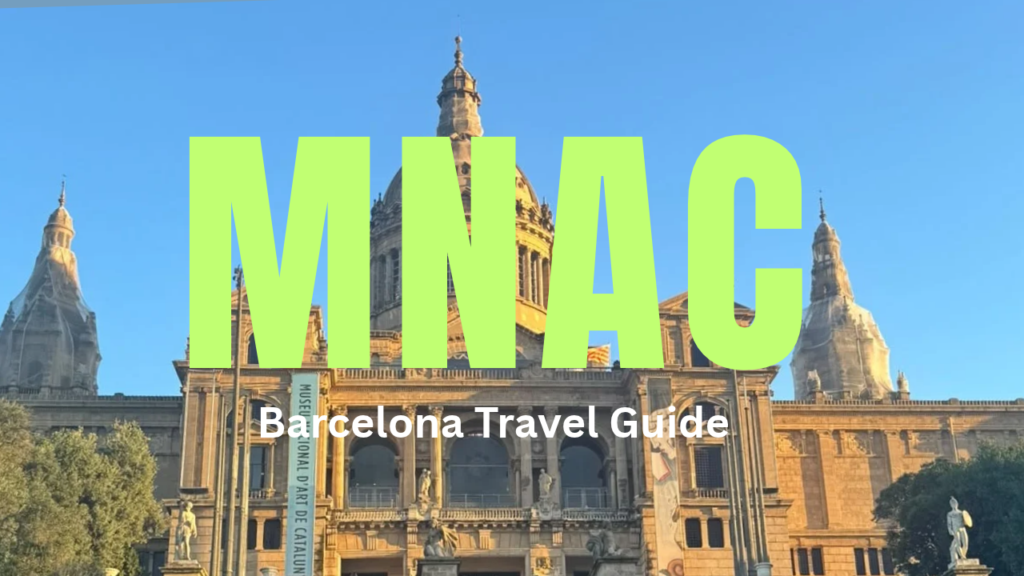
Museu Nacional d’Art de Catalunya: The Complete Guide to MNAC Barcelona
Barcelona is famous for the architectural imagination of Antoni Gaudí, the lively streets of the Gothic Quarter, the Mediterranean coastline, and its extraordinary cultural heritage. However, one of the city’s most rewarding cultural destinations stands high above Plaça d’Espanya on Montjuïc Hill: the Museu Nacional d’Art de Catalunya, widely known as MNAC.
Housed inside the magnificent Palau Nacional, MNAC brings together centuries of Catalan artistic history, monumental architecture, religious paintings, Gothic masterpieces, Modernisme, photography, and European art. Its position overlooking Barcelona also makes it an attractive destination for visitors who want to combine a museum visit with spectacular city views.
Whether you are visiting Barcelona for the first time, researching Catalan culture, planning a photography trip, or looking for an enriching day out, this comprehensive guide explains what makes MNAC special and how to plan your visit.
From the origins of the palace to its remarkable Romanesque paintings, from its grand staircase to its rooftop viewpoints, this guide covers the essential details for exploring one of Barcelona’s most important cultural institutions.
What Is the Museu Nacional d’Art de Catalunya?
The Museu Nacional d’Art de Catalunya is the National Art Museum of Catalonia, a major public art museum in Barcelona, Spain. Its collections tell the story of artistic creation in Catalonia across different periods, with important works from Romanesque, Gothic, Renaissance, Baroque, and modern art.
The museum is particularly celebrated for its collection of Romanesque mural paintings, which preserves remarkable examples of medieval religious art removed from historic churches and conserved for future generations.
Unlike a museum devoted to just one artist or period, MNAC offers a broad journey through art and cultural history. Visitors can move from medieval churches and altarpieces to elegant Gothic paintings, nineteenth-century Catalan art, Modernisme, and twentieth-century artistic movements.
Essential facts about MNAC
- Official name: Museu Nacional d’Art de Catalunya.
- Common abbreviation: MNAC.
- Location: Palau Nacional, Parc de Montjuïc, Barcelona, Catalonia, Spain.
- District: Sants-Montjuïc.
- Museum opening: 1934.
- Building: Palau Nacional, constructed for the 1929 International Exposition.
- Best known for: Its exceptional Romanesque mural paintings and Catalan art collections.
- Other highlights: Gothic art, Modernisme, Renaissance and Baroque paintings, photography, temporary exhibitions, and panoramic views.
- Official website: https://www.museunacional.cat/en
The museum is both an art destination and an architectural landmark. Even visitors who do not intend to spend several hours studying paintings may appreciate the palace, its monumental spaces, and the views from Montjuïc.
Where Is MNAC Located in Barcelona?
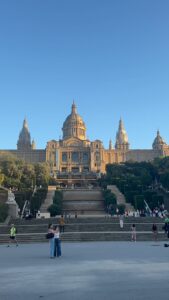
MNAC occupies the Palau Nacional on Montjuïc Hill, a prominent area southwest of Barcelona’s historic centre. The palace overlooks the broad avenue leading towards Plaça d’Espanya and forms one of the most recognisable features of the Montjuïc landscape.
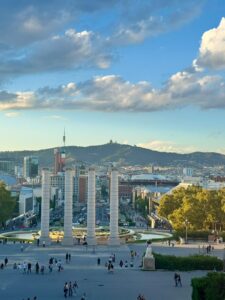
Its elevated position provides a different perspective on the city. From the surrounding terraces and viewpoints, visitors can see Barcelona’s urban landscape, including areas around Plaça d’Espanya and, depending on visibility and viewpoint, parts of the city extending towards the Mediterranean.
The museum is a useful stop when exploring Montjuïc, an area associated with museums, gardens, sporting facilities, cultural venues, and the legacy of the 1929 International Exposition and the 1992 Olympic Games.
Why is the location important?
Montjuïc has long played an important role in Barcelona’s cultural and public life. The development of the area for the International Exposition transformed its slopes into a setting for monumental buildings, landscaped spaces, exhibition venues, and public approaches.
MNAC therefore sits within a wider cultural landscape rather than in isolation. Its position allows visitors to combine art with outdoor exploration and an understanding of Barcelona’s twentieth-century urban development.
History of the Museu Nacional d’Art de Catalunya
The history of MNAC is closely connected to the history of Catalan cultural identity, the preservation of medieval art, and the development of Barcelona as a major European city.
To understand the museum, it helps to separate the history of its building from the history of the institution and its collections.
The International Exposition of 1929
The Palau Nacional was constructed for the Barcelona International Exposition of 1929, a major event intended to showcase industrial progress, technology, design, architecture, and culture.
Barcelona used the exposition as an opportunity to reshape parts of Montjuïc. Exhibition halls, monumental approaches, gardens, and other architectural projects helped create a grand setting for international visitors.
The Palau Nacional became one of the exposition’s principal buildings. Its scale, elevated position, and monumental design gave it a prominent place within the event.
The building was conceived as a ceremonial palace rather than as an ordinary exhibition hall. Its large central spaces, formal staircases, decorative interiors, and grand exterior were designed to communicate prestige and cultural ambition.
The opening of the museum in 1934
The museum opened in 1934, initially presenting an important collection of medieval Catalan art.
Its establishment reflected the growing recognition that Catalonia’s artistic heritage deserved systematic preservation, scholarly study, and public presentation.
Medieval churches, religious institutions, and historic buildings contained works that had survived for centuries, but changes in society, building conditions, and the art market created challenges for their long-term protection.
The museum helped preserve and interpret many important works within a dedicated institutional setting.
The Spanish Civil War and the Franco period
The Spanish Civil War, which began in 1936, and the subsequent Franco dictatorship profoundly affected cultural institutions throughout Spain, including those responsible for Catalan heritage.
Political circumstances, changing cultural policies, and institutional reorganisation influenced the way Catalan history and art were presented.
Despite these difficulties, the collections continued to develop, and the museum’s medieval holdings remained central to its identity.
The development of a national art museum
During the twentieth century, Barcelona’s art collections developed through several institutions and organisational changes.
The modern MNAC was established through the integration of major art collections, including those associated with the Museum of Modern Art and the Museum of Romanesque Art of Catalonia. Its institutional development created a broader framework for presenting Catalan artistic history across different periods.
The museum expanded beyond medieval religious art to include Gothic painting, Renaissance and Baroque works, modern art, photography, and other collections.
Modern renovation and presentation
The museum has undergone substantial work to improve its galleries, conservation facilities, visitor experience, and interpretation of its collections.
A significant renewal of the modern art galleries was introduced in 2014, strengthening the presentation of Catalan art from the nineteenth and twentieth centuries.
Today, MNAC combines the responsibilities of a public museum with those of a research, conservation, education, and cultural institution.
Its long-term ambition is to represent Catalan artistic creation across its full historical development, while connecting that history with wider European and international artistic movements.
Palau Nacional: The Building That Houses MNAC
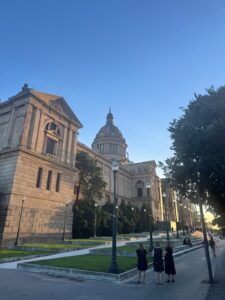
The Palau Nacional is one of Barcelona’s most impressive monumental buildings. Its enormous scale, formal symmetry, domes, towers, and elevated position make it a landmark visible from many parts of the city.
The palace was created for the 1929 International Exposition and later adapted to serve as the home of the National Art Museum of Catalonia.
Architectural style of the Palau Nacional
The palace is associated with monumental academic architecture and classicising design, incorporating influences drawn from historical European palace architecture.
Its appearance communicates grandeur and ceremony. Rather than following the more organic forms associated with Antoni Gaudí, the building uses symmetry, carefully ordered façades, monumental staircases, and an imposing central composition.
The architecture reflects the public ambitions of the International Exposition, when Barcelona sought to present itself as a modern city with a rich cultural identity.
The monumental façade
One of the most striking features of the palace is its broad principal façade.
The exterior is organised around a dominant central section, with wings extending to either side. Large openings, architectural detailing, towers, and domed elements contribute to its impressive silhouette.
When approaching the building from the direction of Plaça d’Espanya, visitors can appreciate how the palace appears to rise above the surrounding landscape.
The scale becomes particularly apparent when viewed from the lower approaches, where the long stairways and terraces emphasise the building’s height.
The grand staircase
The approach to the palace is one of the defining elements of the visitor experience.
The monumental stairways connect the lower areas around Montjuïc with the elevated palace entrance. They provide changing perspectives of the building and the city as visitors ascend.
The staircase is also a popular place for photography, particularly when the palace is framed against the sky or when the surrounding fountains and approaches are included in the composition.
Visitors should remember that the route involves an uphill approach if they choose to walk from Plaça d’Espanya.
The domes and towers
The central dome and the smaller domed and tower elements contribute to the palace’s distinctive skyline.
These architectural features give the building a ceremonial character and help establish a visual connection with historic European exhibition palaces and monumental public buildings.
Their arrangement also reinforces the symmetry of the palace when viewed from the front.
Interior halls and monumental spaces
Inside the palace, visitors encounter large halls, formal circulation spaces, decorative surfaces, and galleries adapted for museum use.
The interiors provide a contrast with the comparatively intimate experience of viewing individual artworks. Visitors can appreciate both the architecture of the building and the works displayed within it.
The Oval Hall is particularly notable for its enormous scale and distinctive elliptical plan. Its monumental interior illustrates the building’s original exhibition-era ambition.
The museum’s interior spaces are part of the attraction, not merely a container for the collection.
Is the Palau Nacional worth visiting without seeing the entire collection?
Yes. Visitors interested mainly in architecture, city views, or photography may still find the palace and its surrounding setting worthwhile.
However, access arrangements and ticket conditions vary. Check the official website to confirm which areas are included in the ticket you intend to purchase.
The Art Collections at MNAC
The museum’s collections cover several major periods of Catalan and European art. The most effective way to explore them is to understand how the works relate to the societies, beliefs, and artistic developments that produced them.
Romanesque art: The museum’s signature collection
Romanesque art is one of the principal reasons MNAC attracts international visitors.
Romanesque art developed across much of Europe during the medieval period, particularly between approximately the eleventh and thirteenth centuries. In Catalonia, churches and monasteries became important settings for painted decoration, sculpture, altarpieces, and religious imagery.
Many works were created to communicate biblical stories and Christian beliefs to communities in which visual images played an important educational and devotional role.
Sant Climent de Taüll
The paintings associated with Sant Climent de Taüll are among the most famous works in MNAC’s Romanesque collection.
The church of Sant Climent de Taüll stands in the Vall de Boí in the Catalan Pyrenees. Its painted apse is renowned for the monumental image of Christ in Majesty, traditionally known as the Pantocrator.
The composition presents Christ in a powerful, frontal pose, surrounded by symbolic figures and inscriptions. Its simplified forms, expressive outlines, strong colours, and carefully ordered arrangement demonstrate the visual language of Romanesque religious painting.
The museum’s presentation allows visitors to appreciate the scale and structure of this medieval art in a controlled environment.
Santa Maria de Taüll
The nearby church of Santa Maria de Taüll also contributes to the museum’s important Romanesque holdings.
Its paintings demonstrate how colour, symbolic figures, and carefully structured compositions were used to communicate religious narratives.
Together, the Taüll paintings offer insight into the artistic culture of medieval communities in the Pyrenees.
Sant Quirze de Pedret
The paintings associated with Sant Quirze de Pedret provide another important example of Catalan Romanesque art.
Their distinctive imagery and decorative forms demonstrate the variety that existed within medieval religious painting. They also show that Romanesque art was not simply a single, unchanging style.
Santa Maria d’Àneu
The mural paintings associated with Santa Maria d’Àneu are another significant part of the collection.
They help visitors understand the role of churches as decorated spaces, where painting, architecture, liturgy, and religious belief worked together.
Why were medieval mural paintings transferred to museums?
Wall paintings are vulnerable to moisture, changes in building use, neglect, and deterioration. In the early twentieth century, the preservation of important mural paintings in the Pyrenees became an urgent concern.
Many paintings were transferred from their original architectural settings to protect them and allow them to be studied and displayed.
The process was technically complex. Specialists separated painted plaster from walls, conserved the material, and installed it on new supports for museum presentation.
Although this approach helped preserve vulnerable works, it also changed their relationship with the original churches. Seeing the paintings in a museum therefore offers an exceptional opportunity to study them, while the churches themselves remain important to understanding their original context.
Gothic art: Colour, detail, and devotion
The Gothic collection demonstrates the development of Catalan painting and sculpture during the later Middle Ages.
Gothic artists increasingly explored detailed settings, expressive faces, decorative patterns, elaborate garments, and more naturalistic representations of people and objects.
Altarpieces were particularly important. These large painted or sculpted structures were placed behind or near church altars and often presented saints, biblical events, and scenes from the life of Christ or the Virgin Mary.
Jaume Huguet
Jaume Huguet was one of the most important Catalan painters of the fifteenth century.
His work reflects the sophistication of late Gothic painting in Catalonia, including careful detail, expressive religious figures, and elaborate narrative compositions.
MNAC’s Gothic collection helps place Huguet within the wider artistic culture of medieval Barcelona and its surrounding regions.
Lluís Dalmau
Lluís Dalmau is another important figure in Catalan Gothic art.
His work is associated with the growing influence of northern European painting, including greater attention to naturalistic detail and the representation of individual figures.
Bernat Martorell and Lluís Borrassà
Bernat Martorell and Lluís Borrassà are also significant artists within the history of Catalan Gothic painting.
Their works demonstrate the richness of medieval altarpiece production and the importance of religious commissions to artistic life.
When viewing Gothic works, pay attention to the details of clothing, architectural backgrounds, gestures, and symbolic objects. These features often communicate meaning beyond the main scene.
Renaissance and Baroque art
The museum also presents works associated with the Renaissance and Baroque periods.
Renaissance art is often associated with renewed interest in classical antiquity, human anatomy, perspective, and the study of the natural world.
Baroque art frequently emphasises drama, movement, emotional intensity, rich colour, and powerful contrasts of light and shadow.
MNAC’s holdings connect Catalan artistic history with wider European developments, illustrating how artistic styles travelled, changed, and were adapted to different religious and cultural environments.
Titian and Velázquez
Works by major European painters, including Titian and Diego Velázquez, contribute to the museum’s broader historical perspective.
Their presence helps visitors understand Catalan art in relation to the larger artistic networks of Europe.
Rather than treating Catalonia as an isolated artistic region, the collection shows how its visual culture developed alongside wider European traditions.
Catalan Modernisme
Modernisme was a major cultural movement in Catalonia around the late nineteenth and early twentieth centuries.
It influenced architecture, painting, decorative arts, graphic design, furniture, and other creative fields.
Modernisme developed during a period of significant economic, social, and cultural change. Barcelona’s expanding urban environment, industrial development, and renewed interest in Catalan cultural identity helped create conditions in which the movement flourished.
Although Antoni Gaudí is its most internationally famous architectural figure, Modernisme was a broad movement involving many artists and designers.
Ramon Casas
Ramon Casas was an influential Catalan painter associated with modern urban life and the artistic culture of Barcelona.
His work often reflects contemporary society, cafés, public spaces, fashionable figures, and changing ideas about modernity.
His paintings provide a visual record of a city experiencing social and cultural transformation.
Santiago Rusiñol
Santiago Rusiñol was an important painter and writer associated with Catalan Modernisme.
His artistic interests included landscapes, gardens, and atmospheric settings. His work helps illustrate the movement’s engagement with modern life and the relationship between art and cultural identity.
Antoni Gaudí and modern Catalan art
Gaudí is primarily celebrated as an architect, but his work forms part of the wider artistic environment explored by MNAC.
His buildings demonstrate how architecture, sculpture, colour, craft, and decorative design could be combined into a unified artistic experience.
Visitors who have seen the Sagrada Família, Casa Batlló, or Park Güell may find that the museum’s modern art displays offer a broader context for understanding the period in which these works developed.
Marià Fortuny and The Spanish Wedding — La Vicaria
One of the museum’s celebrated modern paintings is La Vicaria, also known in English as The Spanish Wedding, by Marià Fortuny.
The painting is admired for its detailed depiction of figures, costumes, interiors, and social interaction.
Fortuny’s technical skill is especially apparent in the rendering of textures, fabrics, reflective surfaces, and the different personalities of the figures.
Rather than presenting a monumental historical event, the painting draws attention to a carefully observed social scene.
Look closely at the way the figures are arranged, how the light falls across the room, and how individual gestures contribute to the narrative.
Modern art and the avant-garde
MNAC’s modern art collections extend beyond Modernisme into the artistic experiments of the twentieth century.
The period brought major changes in painting, sculpture, and visual culture. Artists questioned traditional representation, experimented with abstraction, and explored new ways of expressing personal, social, and political experiences.
Pablo Picasso
Picasso’s early artistic development is closely connected to Barcelona, where he studied and encountered a lively cultural environment before becoming one of the most influential artists of the twentieth century.
Seeing works connected with his early development can help visitors understand his relationship with the city.
Joan Miró
Joan Miró was another major Catalan artist whose work became internationally recognised.
His artistic language developed through experimentation with colour, line, symbols, and increasingly imaginative forms.
His career illustrates the connection between Catalan artistic culture and international modernism.
Photography
Photography is another important part of MNAC’s broader artistic scope.
Photographic collections allow visitors to explore changing visual practices, technological developments, documentary approaches, and the ways photographers recorded people, places, and social conditions.
Photography also helps connect artistic history with everyday life. It can reveal changes in clothing, architecture, urban landscapes, and cultural attitudes that paintings alone may not fully communicate.
Temporary exhibitions
Alongside its permanent collections, MNAC organises temporary exhibitions, research presentations, and cultural programmes.
These exhibitions may focus on particular artists, historical periods, themes, collections, or contemporary interpretations of art.
The programme changes over time, so visitors should consult the museum’s official exhibitions page before travelling.
Official information: https://www.museunacional.cat/en
What Should You See First at MNAC?
The museum is large, so a little planning can make your visit more rewarding.
If this is your first visit, consider prioritising the following highlights.
1. The Romanesque mural paintings
Begin with the Romanesque galleries if you want to understand the collection’s international importance.
Look for the paintings from Sant Climent de Taüll and compare their monumental figures, colours, and symbolic compositions with other medieval works.
2. The Gothic altarpieces
Explore the Gothic galleries to see how painting developed from strongly stylised medieval compositions towards more elaborate narrative scenes and greater attention to detail.
3. The Modernisme galleries
Move on to the modern collections to understand the artistic transformation of Catalonia during the late nineteenth and early twentieth centuries.
Works by artists such as Ramon Casas and Marià Fortuny provide useful connections between art, society, and everyday life.
4. The European paintings
Spend time with the Renaissance and Baroque works to compare Catalan art with broader European traditions.
Notice differences in lighting, composition, scale, and the treatment of human figures.
5. The palace interior and viewpoints
Do not leave without appreciating the architecture itself.
The monumental interior spaces and available rooftop viewpoints offer a different experience from the galleries and help make the visit more varied.
Rooftop Views and Photography at MNAC
The elevated position of MNAC is one of its greatest attractions.
The surrounding terraces and designated rooftop viewpoints provide opportunities to appreciate Barcelona from above.
What can you see from the viewpoints?
Depending on the precise viewing area, weather, and visibility, you may see:
- Plaça d’Espanya and the avenues leading away from it.
- Parts of Barcelona’s urban skyline.
- The surrounding Montjuïc landscape.
- Architectural landmarks and public spaces in the wider city.
- Distant areas towards the Mediterranean on clear days.
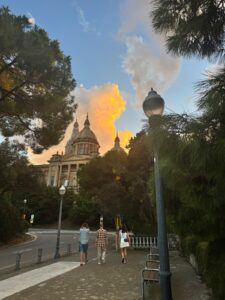
The view changes with the weather and time of day. Bright afternoons can offer excellent visibility, while late afternoon may produce softer light for photography.
Photography tips for visitors
If you enjoy travel photography, plan time for both exterior and interior images.
For exterior photography, try a wide composition that includes the palace and its surroundings. From lower viewpoints, the monumental staircase can help create depth and scale.
For city views, look for clear sightlines and avoid rushing between photographs. A few carefully composed images are often more effective than dozens of nearly identical shots.
Inside the museum, follow the photography rules displayed in each gallery. Some works or temporary exhibitions may have restrictions, and flash photography should not be used where prohibited.
Always check the museum’s current rules before publishing commercial or promotional images.
Is MNAC a good place for sunset photography?
The Montjuïc area can be attractive in the late afternoon, but access to the museum’s rooftop viewpoints depends on the museum’s operating schedule and ticket conditions.
Do not assume that the museum’s rooftop remains open after the galleries close. If sunset photography is your main objective, check the official schedule for the specific date and identify accessible outdoor viewpoints nearby as an alternative.
MNAC Opening Hours
Opening hours can change because of public holidays, special events, seasonal schedules, and temporary arrangements.
The museum’s published general schedule is:
- October to April: Tuesday to Saturday, 10:00 am to 6:00 pm.
- May to September: Tuesday to Saturday, 10:00 am to 8:00 pm.
- Sundays and public holidays: 10:00 am to 3:00 pm.
- Mondays: Closed, except when a public holiday affects the schedule.
- Annual closure: January 1, May 1, and December 25.
Ticket offices normally close 30 minutes before the museum closes, and galleries begin to empty 15 minutes before closing.
Always verify the latest information before your visit: https://www.museunacional.cat/en/opening-hours-and-prices
What is the best time of day to visit?
For a relaxed visit, arriving near opening time is a sensible choice.
Morning visits give you more time to explore the permanent galleries before the afternoon closing period on Sundays. On longer opening days, you can also plan a break and spend additional time in the modern art galleries or temporary exhibitions.
If you mainly want the exterior, palace architecture, and viewpoints, allow enough time for the approach from Plaça d’Espanya and the surrounding Montjuïc landscape.
MNAC Tickets and Entrance Fees
The museum publishes different ticket options, and the correct choice depends on whether you want to explore the art collections or concentrate on the building and viewpoints.
According to the museum’s published ticket information, the standard prices include:
- General admission: €12. Includes the permanent collection, temporary exhibitions, and rooftop viewpoints, subject to the ticket conditions.
- Basic admission: €2. Provides access to the building, viewpoints, and a self-guided visit focused on the building’s spaces, subject to current access arrangements.
The general ticket is published as valid for two days within one month of the purchase date. Confirm the exact conditions when booking.
Can you visit MNAC for free?
Yes. The museum’s published policy includes free admission to the collections on Saturdays from 3:00 pm and on the first Sunday of each month, as well as selected open-door days.
Advance online reservation may be required, even for free entry.
Certain groups may also qualify for free admission or discounts, subject to eligibility and proof of status. Check the official website for the latest terms before relying on a concession.
Important: Free admission to the collections is different from the basic building ticket. Verify whether the areas you want to visit are included in your chosen ticket.
Is booking tickets online recommended?
Online booking is a good idea, especially if you want to visit during a popular period or take advantage of a free-entry session.
Check the official website for ticket availability, temporary exhibition conditions, and any changes to opening hours.
Official ticket information: https://www.museunacional.cat/en/opening-hours-and-prices
How to Get to MNAC Barcelona
MNAC is located on Montjuïc, and several public transport options connect the area with the rest of Barcelona.
By metro
The nearest major metro interchange is Plaça d’Espanya, served by metro lines L1 and L3.
From Plaça d’Espanya, visitors can walk towards the palace using the monumental approach. Be aware that the route includes an uphill section and staircases.
If walking uphill is difficult, check available bus connections or accessible routes before setting out.
By bus
Bus routes serving the Montjuïc area include routes that connect Plaça d’Espanya with the museum and nearby cultural attractions.
Routes and stops can change, so check the current Barcelona public transport information on the day of your visit.
By train
FGC trains serve Espanya station, providing another option for visitors travelling from parts of the Barcelona metropolitan area and beyond.
From the station, continue towards the museum using the available pedestrian or bus connections.
By tourist bus
Barcelona’s tourist bus services include stops serving the MNAC and Montjuïc area, depending on the route and current operating arrangements.
This can be convenient if you are visiting several major attractions in one day.
By taxi or ride-hailing service
A taxi can reduce the amount of uphill walking, particularly for families, older visitors, or people with limited mobility.
Confirm the most convenient drop-off point and any access restrictions before travelling.
Walking from Plaça d’Espanya
Walking from Plaça d’Espanya is a popular option because the approach provides impressive views of the palace and surrounding area.
Allow extra time for photographs, resting, and enjoying the setting. In hot weather, carry water and avoid assuming the climb will be effortless.
Accessibility and Facilities
Accessibility is an important consideration when planning a museum visit.
The museum provides accessibility information for visitors with mobility requirements, and the building has visitor facilities intended to support access to its public areas.
However, the exterior approach includes slopes and staircases, and the most convenient route may depend on current lift access, entrances, and temporary arrangements.
Before travelling, check the museum’s official accessibility information if you use a wheelchair, have limited mobility, or are visiting with a pushchair.
Other visitor facilities may include information services, a shop, food and drink options, audio guides, and educational resources. Availability and opening hours can differ from those of the main galleries.
Visiting with children
MNAC can be a rewarding destination for families interested in history, painting, and architecture.
To keep the visit manageable, choose a few highlights rather than trying to examine every gallery. The Romanesque paintings, large palace spaces, and city viewpoints can help younger visitors engage with the experience.
Check the museum’s current family activities and rules for pushchairs before arriving.
How Much Time Do You Need at MNAC?
The time needed depends on your interests and pace.
- 45–90 minutes: A short visit focused on the building, selected highlights, and viewpoints, subject to ticket access.
- 2–3 hours: A good introduction to the main art collections and the palace.
- 3–4 hours or more: Suitable for visitors who want to explore multiple periods, read the explanatory material, see temporary exhibitions, and take breaks.
Art enthusiasts and visitors conducting research may want considerably longer.
For a first visit, around two to three hours is a practical starting point if you want more than a quick look around.
A Self-Guided MNAC Tour: Step by Step
The following itinerary is designed for first-time visitors who want to experience the palace, major art periods, and the surrounding setting without rushing.
Stop 1: Begin at Plaça d’Espanya
Start at Plaça d’Espanya and look towards Montjuïc.
Take a moment to observe the urban layout and the way the monumental approach directs attention towards the palace.
If you have time, photograph the surrounding architecture before starting the ascent.
Stop 2: Explore the palace exterior
Walk towards the Palau Nacional and appreciate the symmetry of the façade, domes, towers, and large staircases.
Consider how the building’s scale reflects the ambitions of the 1929 International Exposition.
Stop 3: Enter the museum and orient yourself
Once inside, check the gallery map and current exhibition information.
Prioritise the Romanesque collection if it is your main reason for visiting, then plan your route through the other galleries.
Stop 4: Spend time with Romanesque art
Study the mural paintings from Sant Climent de Taüll and compare them with other examples of medieval art.
Notice the use of colour, simplified forms, symbolic gestures, and the relationship between images and religious ideas.
Stop 5: Continue to the Gothic collection
Look at the altarpieces and compare their detail and narrative complexity with the Romanesque works.
Pay attention to how artists represented clothing, faces, architecture, and scenes from religious stories.
Stop 6: Explore Renaissance, Baroque, and modern works
Move through the later collections to understand how artistic styles and cultural priorities changed.
Look for works by major Catalan artists and compare them with broader European developments.
Stop 7: Visit the viewpoints if included in your ticket
Finish the indoor visit with time for the designated viewpoints, provided they are open and included in your admission.
Enjoy the city panorama and take photographs where permitted.
Stop 8: Explore Montjuïc
If you still have time, continue exploring nearby cultural venues, gardens, and public spaces.
The area offers enough variety to turn a museum visit into a half-day or full-day excursion.
Places to Visit Near MNAC
MNAC is surrounded by cultural attractions and public spaces that can easily be combined with your visit.
Plaça d’Espanya
Plaça d’Espanya is a major transport junction and one of the main gateways to Montjuïc.
Its broad roads, monumental setting, and proximity to the palace make it a natural starting or ending point for a museum trip.
Magic Fountain of Montjuïc
The Magic Fountain is a well-known landmark in the area below MNAC.
Its operation, performances, and access arrangements can change because of maintenance, energy restrictions, public events, or other circumstances. Check current local information rather than assuming a show will take place on your visit date.
Poble Espanyol
Poble Espanyol is an architectural and cultural attraction that presents examples of Spanish regional architectural styles within a purpose-built setting.
It can be a useful addition for visitors interested in architecture, craft, and cultural tourism.
Check opening hours and ticket combinations before planning both attractions on the same day.
Fundació Joan Miró
The Fundació Joan Miró is another major art destination on Montjuïc, dedicated to the work and legacy of Joan Miró.
It provides a complementary experience for visitors interested in modern and contemporary art.
Allow enough time for transport or walking between the sites.
Montjuïc gardens
The hillsides of Montjuïc include gardens and landscaped areas where visitors can take a break from museums.
Walking conditions vary by route, and some areas involve steep slopes. Choose a path appropriate for your fitness level and the weather.
Food and Drink Near MNAC
A visit to MNAC can be combined with a meal or coffee in the Montjuïc area or around Plaça d’Espanya.
The museum has offered café and restaurant facilities, but opening hours and availability should be checked before relying on them.
For more choice, the areas around Plaça d’Espanya and nearby neighbourhoods provide additional places to eat.
If you are planning a long museum visit, consider eating before entering or allowing a break between galleries. Check whether your ticket permits re-entry if you intend to leave the building during your visit.
Practical Tips for Visiting MNAC
A little preparation can make a substantial difference to your experience.
Wear comfortable shoes
The approach from Plaça d’Espanya includes uphill walking and stairs. Comfortable footwear is particularly useful if you plan to explore other parts of Montjuïc afterwards.
Check the weather
Barcelona can be hot in summer, while windy or rainy conditions may make the exposed outdoor areas less comfortable.
Carry water in warm weather and allow time to rest during the climb.
Reserve free-entry tickets in advance
If you plan to visit during a free-entry period, check whether online reservations are required and whether tickets remain available.
Check temporary exhibitions
The museum’s exhibition programme changes. Reviewing it in advance helps you identify any displays that are particularly relevant to your interests.
Read the artwork labels
Even a short explanation can make medieval art much easier to understand. Look for the work’s title, date, original location, artist attribution, and historical context.
Respect museum rules
Follow photography instructions, keep a suitable distance from artworks, and comply with restrictions on food, drinks, bags, and other visitor behaviour.
Plan your route home
Montjuïc is elevated, and the return journey may involve stairs, slopes, or a different transport route from the one you used to arrive.
Is MNAC Worth Visiting?
For many visitors, MNAC is one of Barcelona’s most rewarding cultural attractions.
Its greatest strength is the combination of an impressive monumental building and a collection that tells a long story about Catalan artistic history.
The Romanesque galleries are particularly important for anyone interested in medieval European art, while the Gothic and modern collections offer opportunities to compare artistic developments across centuries.
The palace itself also makes the visit distinctive. Its architecture, elevated position, and viewpoints create an experience that goes beyond the galleries.
MNAC may be less suitable for visitors who have very little time and are not interested in art or architecture. However, even a short visit focused on the building and selected masterpieces can provide a valuable introduction to Barcelona’s cultural heritage.
Frequently Asked Questions About MNAC Barcelona
What does MNAC stand for?
MNAC stands for Museu Nacional d’Art de Catalunya, the National Art Museum of Catalonia.
When did MNAC open?
The museum opened in 1934, while the Palau Nacional building was constructed for the 1929 International Exposition in Barcelona.
What is MNAC famous for?
MNAC is especially famous for its Romanesque mural paintings, including the celebrated paintings associated with Sant Climent de Taüll. It also holds important Gothic, Renaissance, Baroque, modern art, and photography collections.
Where is the Museu Nacional d’Art de Catalunya?
It is located at the Palau Nacional in Parc de Montjuïc, 08038 Barcelona, Spain.
How much does MNAC cost?
The museum’s published general admission price is €12, while its basic building-and-viewpoint ticket is €2. Confirm current prices and inclusions on the official website before visiting.
Is MNAC free on certain days?
Published free-entry periods include Saturdays from 3:00 pm and the first Sunday of each month. Advance reservation may be required, and conditions can change.
How long should I spend at MNAC?
Allow around two to three hours for a first visit. Art enthusiasts may prefer three to four hours or longer.
Can I visit MNAC just for the views?
The museum has offered a basic ticket for access to the building and designated viewpoints. Check current access and ticket conditions before travelling.
How do I get to MNAC by metro?
Take metro line L1 or L3 to Plaça d’Espanya, then continue towards Montjuïc. The walk includes an uphill approach.
Is MNAC suitable for children?
Yes. Families can focus on selected artworks, the building, and the viewpoints rather than trying to see the entire collection.
Is MNAC accessible for wheelchair users?
The museum provides accessibility information, but the most suitable approach and available facilities should be confirmed with the museum before your visit.
Can I take photographs inside MNAC?
Photography rules depend on the gallery and exhibition. Follow the current signs and instructions, and do not use flash where prohibited.
What is the best time to visit MNAC?
Arriving near opening time is a good option for a quieter, more relaxed visit. Check seasonal opening hours and public holidays before setting out.
What can I visit near MNAC?
Nearby attractions include Plaça d’Espanya, the Magic Fountain area, Poble Espanyol, Fundació Joan Miró, and the gardens of Montjuïc.
Final Thoughts: Discover Barcelona Through MNAC
The Museu Nacional d’Art de Catalunya offers an opportunity to discover Barcelona through its art, architecture, and cultural history.
From the monumental Palau Nacional to the medieval paintings of the Pyrenees, from Gothic altarpieces to Catalan Modernisme, the museum brings together artistic traditions that developed across many centuries.
A visit also offers a chance to appreciate Montjuïc, explore nearby attractions, and see Barcelona from an elevated perspective.
Whether you are planning a short cultural stop or a longer art-focused excursion, MNAC deserves a place on your Barcelona itinerary.
Before your visit, confirm opening hours, ticket prices, free-entry conditions, temporary exhibitions, and viewpoint access on the official museum website. A little preparation will help you make the most of this remarkable cultural destination.
Have you visited the Museu Nacional d’Art de Catalunya? Share your favourite artwork or your experience of the palace and its views in the comments. If you are planning a trip to Barcelona, explore more destination guides on Triplivo.com for practical travel tips, cultural highlights, and places worth discovering.